Scope: This guide translates a Chinese-server article about 英雄没有闪, for readers interested in Lootborn Warriors. These findings have not been verified on the global server. Skill, item, and imprint names below are provisional translations, with the Chinese names included for identification.
Source: 邪神攻略站, published October 9, 2026, at 10:18; timezone not specified in the displayed publication timestamp. Original article. Prepared from a user-saved HTML copy.
The author reports that Wound (创伤) retains a snapshot component while responding dynamically to damage-over-time amplification. This makes the order of Wound and Gale Imprint (狂风刻印) significant, and may also affect Sharp Finisher (凌厉终结). The article separately reports a possible Soul Hunt (猎魂) scaling bug.
Reference: the Gale Slash tooltip
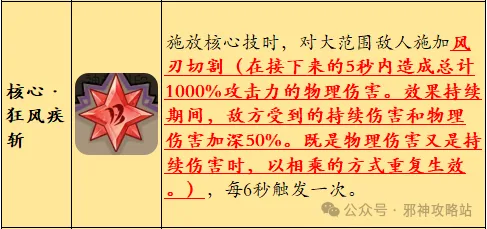
The accompanying image labels the core effect as Gale Slash (狂风疾斩). Its tooltip says that casting a Core Skill applies a gale blade slash to enemies in a large area, dealing physical damage totaling 1,000% of Attack over the next 5 seconds. During that effect, affected enemies take 50% more damage over time and 50% more physical damage. When damage is both physical and damage over time, the two increases multiply. The effect can trigger once every 6 seconds.
This is a translation of the supplied Chinese tooltip, not confirmation of the global-server tooltip or current balance values.
1. The author’s recommendation for a Soul Hunt lightning-blade setup
The author recommends Gale Imprint over Calamity (灾厄) for a lightning-blade setup using Soul Hunt.
Their explanation is that both the Rend (撕裂) effect from Soul Hunt’s exclusive affix and the Cleave (顺劈斩) from its special effect count as physical damage over time. According to the article, both therefore benefit from Gale’s 2.25× multiplier:
1.5× physical-damage amplification × 1.5× damage-over-time amplification = 2.25×.
This is the source author’s recommendation and classification; the article does not provide a full comparative damage log against Calamity.
2. Wound snapshots some modifiers, but DoT amplification updates dynamically
The author previously understood Wound to use a snapshot: its total damage is determined when Wound is applied, and later increases or reductions do not change it. For example, applying a vulnerability effect after Wound would not change its bleed damage.
The article contrasts this with the mage’s Burn (燃烧), Fire Hammer’s Ignite (火锤点燃), Shadowflame’s Scorch (影焰灼烧), and Poison Coating’s poison damage (涂毒剧毒). According to the author, those effects continue to respond to damage modifiers after application.
The newly reported exception for Wound is damage-over-time amplification from imprints. The author says the 50% DoT amplification on both Gale Imprint and Frost Assault Imprint (霜冻突袭刻印) can change damage from an already active Wound.
Why application order matters
Multipliers below are relative to the same Wound without either of Gale’s amplification effects, following the author’s examples.
| Application order | While Gale’s 5-second buff is active | After the buff expires | Author’s explanation |
|---|---|---|---|
| Apply Wound, then trigger Gale Imprint | 1.5× | 1× | Wound responds to the temporary DoT amplification, but never gains the later physical amplification. |
| Trigger Gale Imprint, then apply Wound | 2.25× | 1.5× | Wound snapshots the physical amplification; the DoT amplification applies dynamically and disappears when the buff ends. |
In the second sequence, the 50% physical amplification remains included in that Wound after Gale expires, while the temporary 50% DoT amplification does not. The source reports this behavior; it does not establish that every other modifier follows the same rule.
3. The reported interaction with Sharp Finisher
The author says Wound’s dynamic response to DoT amplification can also affect Sharp Finisher’s damage calculation.
Their illustrative example is:
- A normal Sharp Finisher would deal 100 damage, corresponding to a Wound damage pool of 100.
- With Gale active when Sharp Finisher triggers, that example becomes 225 damage.
- The author interprets this as Sharp Finisher counting the Wound pool at 2.25× under that interaction.
The article explicitly limits this claim to Sharp Finisher’s calculated damage. It does not mean Wound’s own damage is permanently changed to 2.25×; Wound itself continues to follow its applicable modifiers and timing.
The values 100 and 225 are an explanatory example, not a published combat test log or a complete formula for all situations.
4. Two-piece versus four-piece: distinguish tests from player reports
Despite the reported synergy between Sharp Finisher and Gale, the author’s target-dummy tests still favored a two-piece set for the fire-blade setup. They describe the four-piece version as underperforming in those tests.
The author leaves the lightning-blade setup open to further experimentation. They cite a player who reportedly cleared stage 470 at 550,000 power using:
- Mixed jewelry pieces, including a Holy Shield Amulet (圣盾护符).
- A four-piece set.
- Soul Hunt and Gale Imprint.
- Mount gear that the author describes as poor.
This is a reported individual clear. It does not establish that the four-piece setup is consistently stronger. The source does not specify the set’s name or provide a complete equipment list, controlled comparison, or repeatability data.
5. A reported Soul Hunt / Rend scaling bug
Following what the article calls the Phantom Assault incident (幻影突袭事件), the author reports another issue with Soul Hunt:
- Rend previously benefited from a Basic Skill damage multiplier, according to the author.
- They say the previous update removed that skill-damage multiplier from Rend.
- The description, however, says Rend should benefit from Core Skill damage amplification.
The author calls this mismatch a bug and says a follow-up article will discuss it further. This article does not include developer confirmation, a reproduction procedure, the update identifier, or a fix status. Treat it as a reported suspected bug on the Chinese server, pending independent verification.
Practical takeaways from this source
For the Wound interaction described here, Gale before Wound produces the higher multiplier in the author’s examples. Gale is also recommended by the author for Soul Hunt lightning-blade builds because Rend and Cleave are described as physical DoTs. Their fire-blade tests still favor two pieces, while the four-piece lightning-blade option remains exploratory.
Before using these recommendations on the global server, check the actual tooltips, available equipment, patch state, and damage timing in your version.